A plain-English guide
What is Cauda Equina Syndrome?
Cauda Equina Syndrome — CES — happens when the bundle of nerves at the very bottom of the spinal cord becomes severely compressed. It is rare. It is also a medical emergency.
When something — most often a slipped disc — pushes hard against these nerves, they stop working properly. The result can be intense lower-back pain, weakness or numbness in the legs, numbness around the buttocks and genitals (the “saddle area”), and a sudden loss of bladder or bowel control.
Without urgent treatment, the damage can be permanent. That is why doctors describe CES as a surgical emergency — every hour matters. Most patients need an emergency MRI scan and, if CES is confirmed, decompression surgery — ideally within 48 hours of symptoms starting.
Just how rare is it?
1–3
per 100,000
people affected each year — CES is rare.
2–6%
of disc herniations
may result in Cauda Equina Syndrome.
1 in 370
lumbar disc prolapses
research suggests result in CES.
#1
spinal claim
delayed diagnosis is a leading cause of spinal medical-negligence claims in the UK.
Although emergency surgery can prevent further damage, many patients continue to experience lifelong symptoms after treatment.
What causes it?
The most common cause is a herniated lumbar disc — a slipped disc in the lower spine that bulges back into the spinal canal and presses on the nerves. If someone’s spinal canal is already narrow (often from age-related changes), even a moderate disc problem can be enough to trigger CES.
Other causes are less common but important to know about:
- Spinal stenosis — gradual narrowing of the spinal canal, often from arthritis or thickened ligaments.
- Tumours in the lower spine, which can grow large enough to compress the nerves.
- Infection — for example an epidural abscess — which can swell and squeeze the nerves.
- Trauma — a fracture, fall or car accident causing bleeding or bone displacement around the spine.
- Surgical complications — rarely, bleeding or swelling after lumbar surgery or spinal anaesthetic.
- Vascular or congenital problems — such as a spinal arteriovenous malformation, or a narrow canal someone is born with.
Spine anatomy
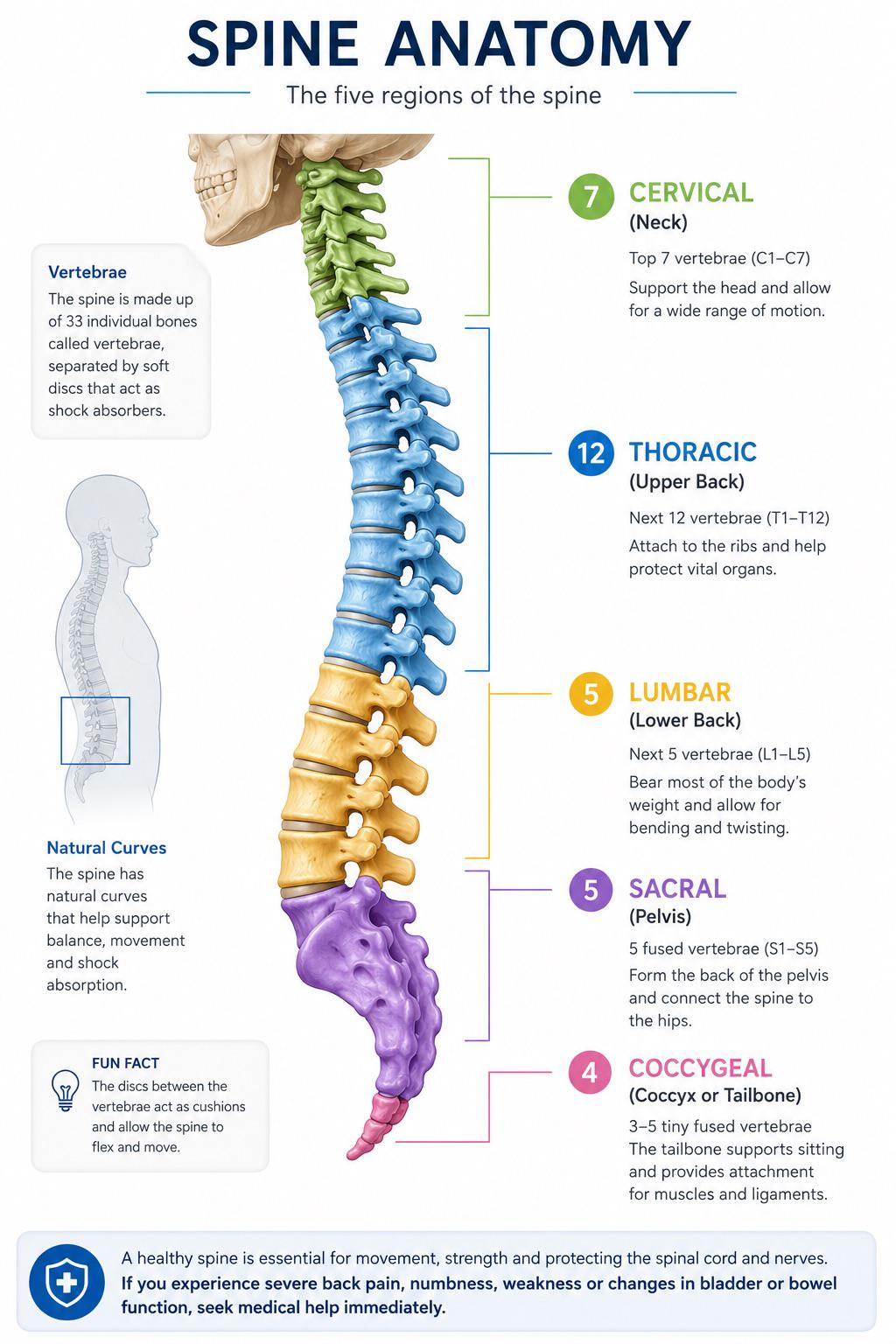
The spine is made up of 33 vertebrae divided into five regions. Together they protect the spinal cord and support movement, balance and sensation throughout the body.
7
Cervical (neck)
C1–C7. Support the head and allow a wide range of motion.
12
Thoracic (upper back)
T1–T12. Attach to the ribs and help protect vital organs.
5
Lumbar (lower back)
L1–L5. Bear most of the body's weight and allow bending and twisting.
5
Sacral (pelvis)
S1–S5, fused. Form the back of the pelvis and connect the spine to the hips.
3–5
Coccygeal (tailbone)
Fused. Supports sitting and provides attachment for muscles and ligaments.
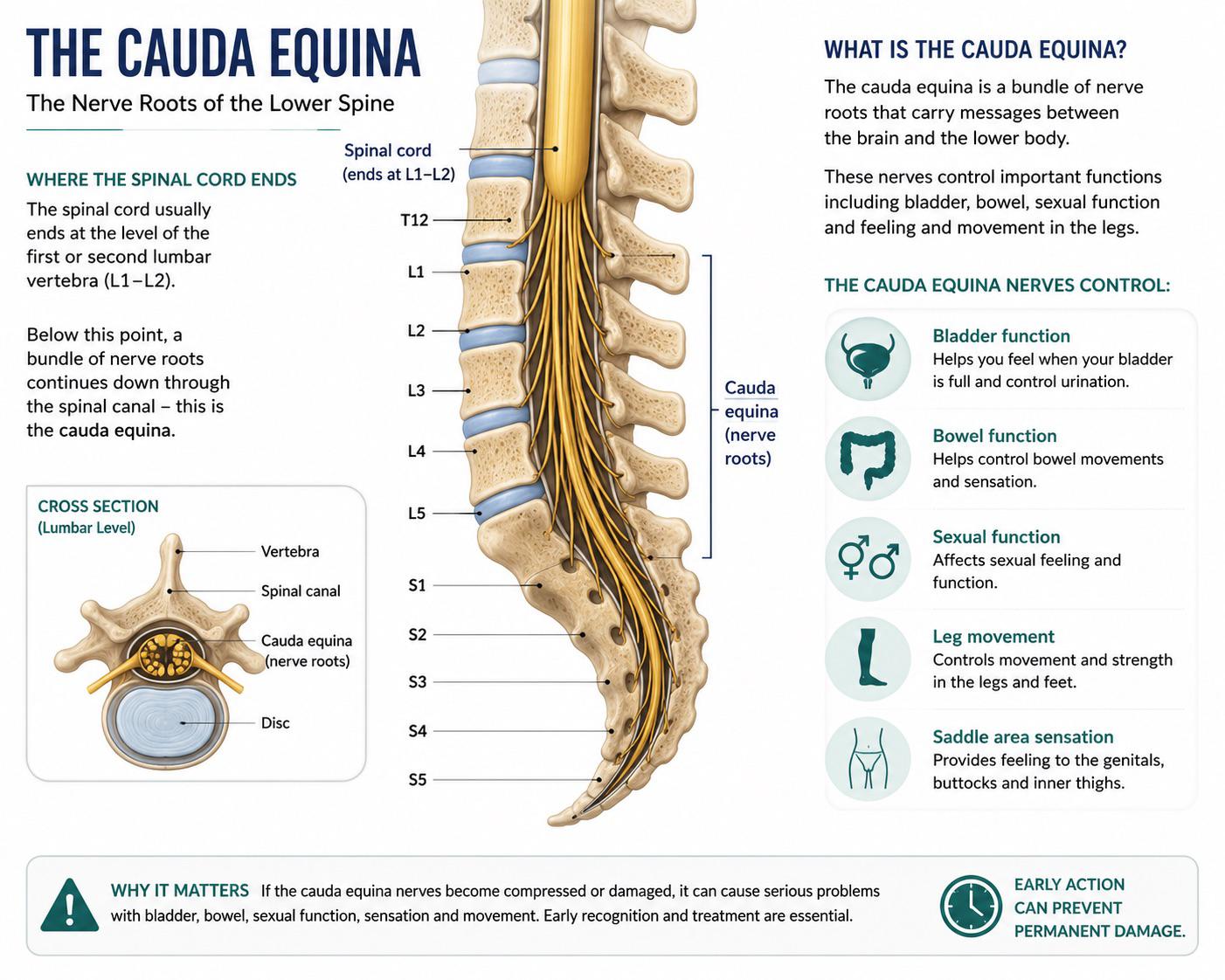
CES most commonly occurs in the lower lumbar spine, where the spinal cord ends and the cauda equina nerves begin.
What the cauda equina nerves control
The spinal cord typically ends around L1–L2. Below that, the cauda equina (Latin for “horse’s tail”) carries messages between the brain and the lower body.
Bladder function
Helps you feel when your bladder is full and control urination.
Bowel function
Helps control bowel movements and sensation.
Sexual function
Affects sexual feeling and function.
Leg movement
Controls movement and strength in the legs and feet.
Saddle sensation
Provides feeling to the genitals, buttocks and inner thighs.
How nerve compression causes CES
A prolapsed (herniated) disc in the lower back can press on the cauda equina nerves, reducing the space they have inside the spinal canal. When the nerves are compressed they may stop working properly — causing saddle numbness, difficulty passing urine, loss of bladder or bowel control, sexual dysfunction, leg weakness and severe nerve pain.
Normal
Plenty of space around the cauda equina nerves inside the spinal canal. Messages travel freely between the brain and lower body.
Compressed
A prolapsed disc presses into the canal, squeezing the nerve roots. If not treated urgently, this can lead to permanent damage.
Early recognition, urgent MRI scanning and prompt treatment give patients the best chance of recovery and reduce the risk of lifelong disability.
Common misconceptions
“It's just back pain.”
CES is much more than back pain. It's a neurological emergency that can affect bladder, bowel, sexual function, mobility and quality of life.
“You must have severe pain to have CES.”
Not always. Some people experience bladder, bowel or sensory symptoms with little or no significant back pain.
“If symptoms come and go, it's not serious.”
Symptoms can fluctuate or develop gradually. Any red-flag symptoms should be assessed urgently.
“Surgery fixes everything.”
While surgery aims to prevent further nerve damage, many people continue to experience long-term symptoms after treatment.
“CES only affects older adults.”
CES can affect adults of any age, and occasionally younger people.
“It's too rare to worry about.”
Although rare, CES can have life-changing consequences. Awareness of the red flags helps ensure earlier diagnosis.
CES is not just “a bad back”. It is a sudden, serious loss of nerve function — and recognising the signs early can be the difference between recovery and lifelong disability.
What to say in A&E
Use these words at triage. They reference NICE guideline NG59, which sets out how CES should be assessed urgently.
I am worried I may have Cauda Equina Syndrome. I have new red flag symptoms — please assess me urgently in line with NICE guideline NG59. My symptoms include: [describe yours, e.g. numbness in the saddle area, loss of bladder or bowel control, bilateral leg pain or weakness, or sexual dysfunction]. I understand I need an urgent MRI of the lumbar spine.
Sources
- National Institute for Health and Care Excellence (NICE) — Guideline NG59
- British Association of Spine Surgeons (BASS)
- NHS England
- Gardner A, Gardner E, Morley T. Cauda Equina Syndrome: A Review of the Current Clinical and Medico-Legal Position. European Spine Journal (2011).
- National Library of Medicine (PubMed)